No, I wouldn't seriously ask that question, would have hoped the answer was obvious.
Anyway, today I noticed that there was an article about stress in horses in the new British Horse magazine.
Good to see.
The article opened by reporting on a survey, which found that 90% of horse owners questioned believe that horses suffer signs of stress or anxiety. 44% have a horse that displays signs of stress, and 84% wish to reduce these signs. The stats look quite nice like this, but looked at another way...
... 1 in 10 horse owners don't believe horses can suffer signs of stress or anxiety
More than half the horses out there have owners who believe they don't display signs of stress
And 1 in 6 owners have no wish to reduce stress signs
Long way to go apparently!
Tuesday, 7 April 2015

Thursday, 1 January 2015
Problem solving ponies
Had an interesting situation yesterday. Some big bales of straw had been delivered to the yard, leaving just a narrow pathway between bales for the horses to go through to get out to their field. The gap was narrow enough that the bigger horses would rub against the bales on both sides as they went.
So, I took the horses out one by one, on very long lead ropes, to see what they would make of it. Benson, Flynn and Paddy viewed it with mild suspicion but walked through of their own accord. Tigger looked at it, snorted, investigated, backed off, and after about 5 minutes and some encouragement leapt through. All pretty normal so far. All of them coped, without getting overly anxious and put up with something a bit challenging to get to the field.
Elvis - approaches, stands still and looks at it. No snorting, no movement, just looking. After a minute or two, he aims at the single bale, approaches at a brisk walk, puts his shoulder into it and rolls it aside. Then walks calmly through the big gap he's opened up. Deeply impressed - one truly problem solving pony!

So, I took the horses out one by one, on very long lead ropes, to see what they would make of it. Benson, Flynn and Paddy viewed it with mild suspicion but walked through of their own accord. Tigger looked at it, snorted, investigated, backed off, and after about 5 minutes and some encouragement leapt through. All pretty normal so far. All of them coped, without getting overly anxious and put up with something a bit challenging to get to the field.
Elvis - approaches, stands still and looks at it. No snorting, no movement, just looking. After a minute or two, he aims at the single bale, approaches at a brisk walk, puts his shoulder into it and rolls it aside. Then walks calmly through the big gap he's opened up. Deeply impressed - one truly problem solving pony!
Wednesday, 5 November 2014
Equine Cushing's disease and behaviour

I'm awaiting blood test results, but the behavioural changes so far are interesting:
- He is interacting much more with the other horses - mutual grooming with his old pal Paddy, and even playing nippy games, which I haven't seen him do in years
- He is more alert and responsive, and keen to interact with people. A few people over the summer had called him 'bargy' - he simply wasn't paying much attention to his environment and was slow to respond. This included not noticing or reacting to people around him. His supposedly 'dominant' behaviour, 'not respecting' people etc. has been miraculously improved by medication...
- He is vocalising more, whinnying to the other horses
- He is muddy! He is rolling more
- Not behavioural, but he's put on weight and muscle tone is looking better.
The downward progression with Benson was very, very gradual. Improvement has been very quick. Apart from the obvious point - test your horse for Cushings if you see any small signs, this is another case where behaviour could easily be attributed to the horse having a 'bad attitude' in one way or another, when they are actually unwell.
Sunday, 26 October 2014
Friendship between horses
Paddy may be hitting his fourth decade, but he is still bright and sociable, and very much a ladies man.Over the last couple of months, he's formed a strong attachment with a very elegant chestnut mare he shares his field with, along with about a dozen other horses.
Today was one of the saddest sights I've seen in a while. The chestnut mare was moved to another field while Paddy was away from the field having his breakfast with my other horses. On turning them all out, the others were calm and behaving as usual. Paddy trotted then cantered up the field, calling and calling for the mare. He checked the whole (very large field), then just stood there whinnying - much more deeply and loudly than usual.
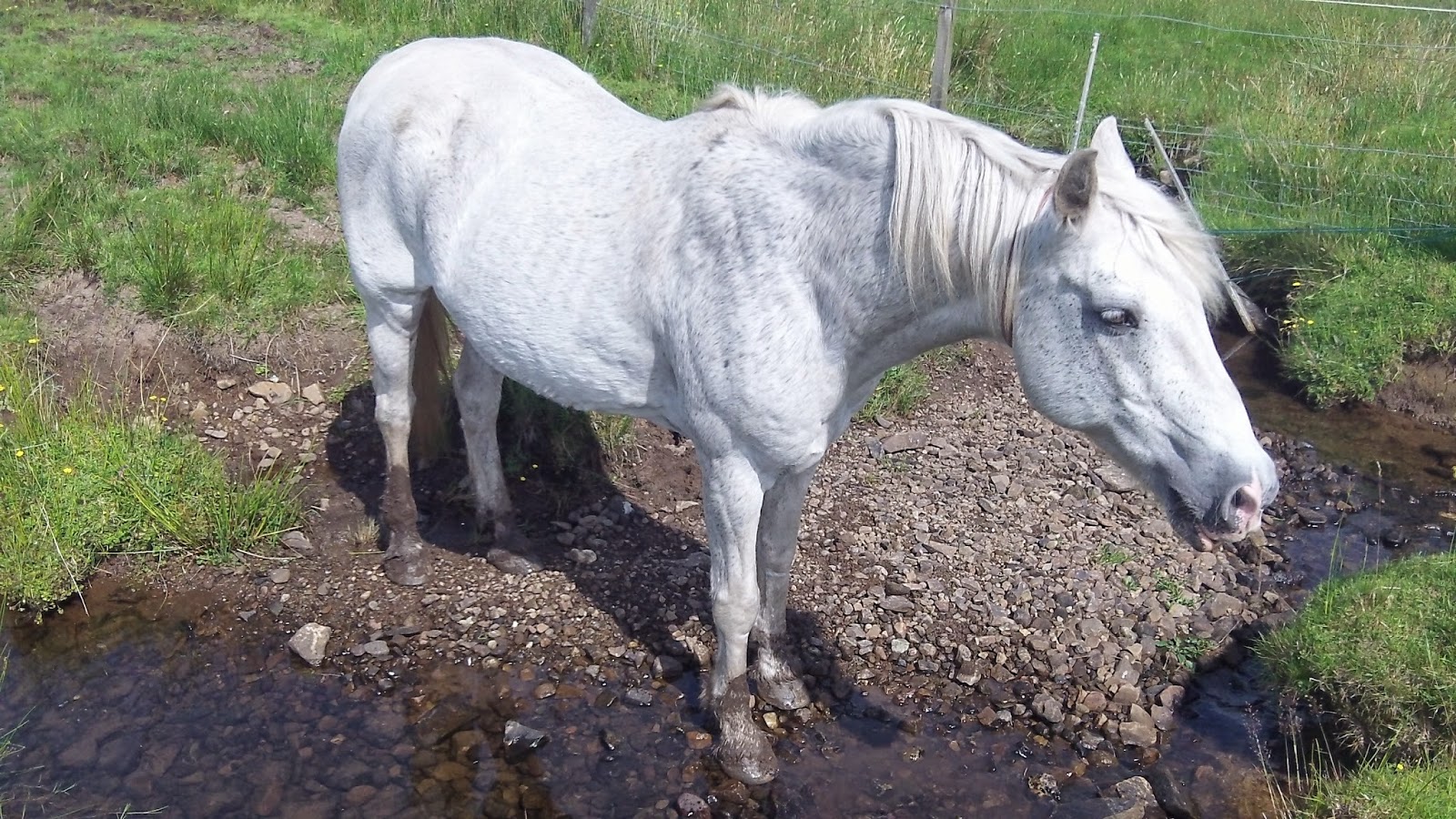
Today was one of the saddest sights I've seen in a while. The chestnut mare was moved to another field while Paddy was away from the field having his breakfast with my other horses. On turning them all out, the others were calm and behaving as usual. Paddy trotted then cantered up the field, calling and calling for the mare. He checked the whole (very large field), then just stood there whinnying - much more deeply and loudly than usual.
No blame to anyone else - Paddy's welfare is my responsibility, and none of us can find a perfect environment for our horses, we just do the best we can. Sharing a field with lots of other horses has been so good for Paddy - the downside is that horses will come and go, for all sorts of reasons.
It really made me think about how we move horses, suddenly breaking bonds and having such a big impact on them - and often with little thought of how this feels from their point of view. We are rightly concerned and careful about introducing new horses, but may give little thought to taking horses away from a group, which is equally significant from the horses point of view. Planning ahead for group stability can make such a difference to your horse and is often undervalued or not considered at all.
Sunday, 21 September 2014
Hair by Benson (mutual grooming)
Benson giving my hair that special extra today - but amazing how gentle he is, especially when he touches my face. Of course you need to be careful about rubbing noses with a horse, but such a shame when bonding behaviours like this are discouraged or misread as the horse being pushy, aggressive etc.
Sunday, 31 August 2014
Sticking to the rules in dressage

Amongst many horse lovers, dressage is getting an increasingly bad name. When I go out to clients I am often struck by their willingness to get help from a riding instructor, but their immediate rejection of an instructor who specialises in dressage - 'I don't like dressage', 'the horses always look so forced', 'I don't want anyone doing that to my horse'. And these views are entirely understandable.
It is sad that a common view now is that dressage aims to produce horses who move in a spectacular way, whilst looking somewhat tormented. It is not, in my opinion, the rules (and aims) of dressage that are causing the problems, it is lack of adherence to the rules - sorry, but a lot of the problem is down to the judges.
The first 2 points in article 401 of the FEI rules illustrate this well:
Article 401 OBJECT AND GENERAL PRINCIPLES OF DRESSAGE
1. The object of Dressage is the development of the Horse into a happy Athlete through harmonious education. As a result, it makes the Horse calm, supple, loose and flexible, but also confident, attentive and keen, thus achieving perfect understanding with the Athlete.
These qualities are demonstrated by:
• The freedom and regularity of the paces.
• The harmony, lightness and ease of the movements.
• The lightness of the forehand and the engagement of the hindquarters, originating from a lively impulsion.
• The acceptance of the bit, with submissiveness/throughness (Durchlassigkeit) without any tension or resistance.
2. The horse thus gives the impression of doing, of its own accord, what is required. Confident and attentive, submitting generously to the control of the Athlete, remaining absolutely straight in any movement on a straight line and bending accordingly when moving on curved lines.
Some would argue, quite fairly, that judgement of these points are subjective, and will always be open to disagreements and interpretation. But really, could anyone say that the above horse is 'giving the impression of doing, of its own accord, what is required'? Or that there is harmony, lightness and ease?
The FEI rules also state that
'Abuse of a horse using natural riding aids or artificial aids will not be tolerated'
another one where the judges seem to be somewhat out of sync with the general horsey public. That the horse and rider pictured above should come 4th in the WEG dressage Grand Prix Special is, in my opinion, deeply concerning. People will justify the scoring, saying that pictures like the one above represent 'just a moment in time', but how many of these moments are tolerated, and how uncomfortable does the horse have to be, for how long, before it is reflected in the scores?
It's a strange world where humble 'happy hackers' would not actually allow a good number of the world's most successful competitive riders within a mile of their horses, but seeing pictures such as the one above, this would certainly be my view.
Thursday, 7 August 2014
How to put horsey people off science?
A few days ago, I was given a newspaper cutting – in fact I
received 3 copies of it as a few people had seen it and thought I might be
interested. The headline was
‘Not straight from the horse’s mouth – only its eyes and
ears.’
Below that, the catchy line
‘Scientists have discovered the secrets of equine
communication’.
Having just last week finished preparing a weekend’s worth
of teaching material on equine body language, of course I was interested.
My first thought was it seemed a bit of an odd headline, implying
that horses only communicate with their eyes and ears. Horses communicate in many ways – through scent, vocalisation, through body language involving their entire outline, their tails, ears, lips, head position and so on. If scientists had just
proved that they only communicate with eyes and ears, what had I been writing about, finding pictures and videos of for
the last month?
And, to be picky, at most the scientists could have discovered a secret of equine
communication – equine communication is rich and sometimes very subtle, and there is much we still don't know.
Turns out, a title along the lines of ‘Scientists have confirmed one aspect of
equine communication’ might be more accurate.
This is not a criticism of the research, but of how it is
presented by the press. There is a worrying divide between those researching
equine behaviour and those working in the equine industry. The research in this case, understandably, does not live up to the headline and then many of those with experience with horses read on for a bit and think 'I knew that already' or 'that's totally obvious' and go on to dismiss the scientists and their results (yes, I’ve had several emails and messages already scorning this
research), and both sides lose out.
And horses lose out. Because a lot of great research is going on in many areas of
equine behaviour, health and welfare that equine industries, and therefore horses, would really
benefit from. Anything that turns the general equine industry off science, and
discourages them from reading what the researchers have to say is a bad thing,
in my opinion.
Subscribe to:
Posts (Atom)